Pages

Friday, October 16, 2015

What can you do?

Have you ever had a question on a test that asked you what would happen if an animal was taken out of an area? If you were like most of the kids I knew growing up you might have just said "bad things". As a wildlife biologist you get asked this question and it is your job to figure it out. You can do this in a lab or in an actual study out in the field. You have the opportunity to study the effects pollution has on plants and animals in an area. And if you are good at your job you might have the opportunity to fix that problem.


This picture shows the common stereotypes of this job. Yes we love the outdoors and we can work with animals but when push comes to shove we are scientist. This involves long ours of research and late nights.

This is the first of a small series of blogs about what you can do as a wildlife biologist.

Jake B

Thursday, October 15, 2015

Prompt # 4: Delivery and Style of Different Animal Science Sources

       When I went on the internet looking for different sources talking about animal science, I came across two that are both very good, but are very different at the same time. One is a casual blog run by a "farm girl agriculturist", and the other is a scholarly article written by two professionals in the field of animal science.
       The blog that I found is titled "Animal Science News", and can be found here: Animal Science News. This source is very casual and fun to look at. The top of the blog consists of the title with a picture of cows in the background; right away, that catches my attention. It is obvious that the goal of this blog is to inform people about the latest news in animal science, but to also entertain them to keep their interest. The most recent post is a video showing how cows eat. It puts the viewer of the video into the eyes of the cow to see what it is like. Obviously that video isn't teaching people very important information about animal science, but it is keeping their interest and it makes the viewer want to scroll down even more to see what else the blog contains. In my opinion, the style of writing that is used in this blog would be narrative and persuasive. Narrative writing is used to entertain, and this blogger wants to keep the viewer entertained, but also wants to inform them. That is why this source could also have a persuasive style in order to tell the readers all there is to know about animal science. The style of this blog could conclude that the audience is most likely people who just want to learn about animal science for fun. The purpose is most likely to inform and entertain those who come across the blog.
       The second source that I found is an article titled "The Application of Natural Zeolites in Animal Science and Aquaculture", and can be found here: Natural Zeolites in Animal Science. This source isn't as entertaining to look at, but it is very informative on the topic of natural zeolites in animal science and aquaculture. The website that this article is on contains 3 categories at the top: American Society of Agronomy, Crop Science Society of America, and Soil Science Society of America. The style of writing that is used is persuasive. The writers of this article are obviously trying to inform the readers about zeolites; that is the purpose. They aren't trying to provide a form of entertainment such as pictures and videos like the previous blog; just words.
       From each of these sources, the reader gains different information. From the blog, the viewer gets to learn what is new in the industry of animal science, all while enjoying pictures and videos that are also posted. From the other website, the reader learns information about crops, soil, and environment science without being able to look at media such as pictures and videos. In my opinion, the source that we can trust more is most likely the website with articles written by professionals. They know more about the subject in depth, and since they are professionals, they are more trustworthy.

- Jamie R.

Sources:
"The Application of Natural Zeolites in Animal Science and Aquaculture." Science Societies. N.p., n.d. Web. 07 Oct. 2015.
Animal Science News. N.p., n.d. Web. 7 Oct. 2015.


Friday, October 9, 2015

Salaries for Wildlife Biologist

The first time I met the faculty of my College and my major they said that a degree in Fisheries and wildlife will not make you a millionaire. Jobs can be hard to come by and you have to start at the bottom and work your way up.

According to learn.org the average salary for a wildlife biologist is around $62,000 a year. The top ten percent make around $90,000. However the bottom of the chart makes about $30,000. When you start in the field you usually start out as a technician and work your way up. The technician is the group that makes around 30K. Do not start off thinking you will make big bucks because you might be disappointed. Instead you should keep working hard to move up the ladder.


The picture above shows the annual mean wage of wildlife biologist and zoologist.

As you can see in the picture above the states that have the highest mean salary are states that have a large variety of animals and/or woods. Personally I want to go to the East or West Coast but after looking at this picture staying in Michigan wouldn't be a bad thing. As you move towards the interior of the country the landscape becomes prairies and grasslands. Also the population isn't as high as in the states on the Coast.  To make the salaries that are up in the $80-$90,000 you need to look for jobs in the darker blue region.

Jake B.

Sources:
"What Is the Average Salary of a Wildlife Biologist?" Learn.org. Web. 9 Oct. 2015.

Agricultural Engineering Salaries

By: Tyler Lahusky

Average Salaries – In General

            The average salary of an agricultural engineer, like any other career or job, depends upon a multitude of conditions. These conditions may include things like experience level, the company of employment, level in the company ladder, type of engineering (within agricultural engineering), gender or location. First off, we will discuss the average salary throughout the entire United States. In 2015, the average salary of an agricultural engineer within the first 5 years of graduating college was $55,000. ("Future Student FAQs"). The average overall salary of an intermediate level engineer was $77,000, with a range from about $55,000 to $84,000. ("Electrical Engineer II Salary | Salary.com") This range is primarily based on experience level and can extend much higher when someone has a great amount of experience. These agricultural engineers fall into the top 10% category, or the 90th percentile. The average agricultural engineer that fell into the 90th percentile made about $115,680 in a year. ("Agricultural Engineer Salary")

Location and Gender

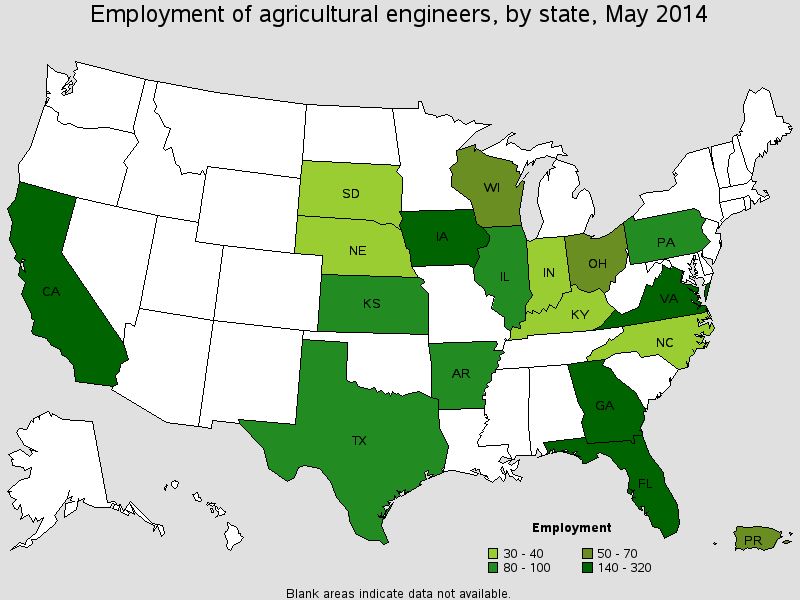
            As you should no know from my last post about the demographics of agricultural engineering, females are not equally represented within the field. Due to this fact, females tend to make more than male agricultural engineers. The average female agricultural engineer made $94,058, while males made from only $35,000 to $84,000. (Purdue University) Along with the gender gap creating a salary gap in agricultural engineering, location plays a major factor in salary. Some states, such as Georgia, have an extremely high average salary for agricultural engineers at $90,000. Other states, such as Florida or Tennessee have an average salary of $45,900 or $35,500 respectively. (Purdue University) ("Agricultural Engineer Salary") See the image and table below to gain a better idea of the breakdown of agricultural engineering salaries by location.

Source: http://www.bls.gov/oes/current/se172021.png

Source: http://engineer-salary.com/agricultural-engineer-salary.html


Discipline

            Depending on the discipline an agricultural engineer goes into within a company will have minor effects on their salary. The highest paying discipline within agricultural engineering is in the professional, scientific, and technical services discipline at $82,720 for an intermediate level engineer. Second is manufacturing, which is what most people think of when they hear ‘engineer’, at $74,560. Third is management tallying in at $74,530 and lastly, public administration at $71,910. ("Electrical Engineer II Salary | Salary.com") There are a number of different disciplines within agricultural engineering besides the four mentioned here, but these four are some of the most popular. Companies themselves also pay their employees differently. Management of any company easily came in first as the ‘highest paying company’. The second highest paying company for agricultural engineers was the federal government with an annual salary of $81,080 on average. ("Highest Paying Industries for Agricultural Engineers")

Source: http://www.usawage.com/high-pay/industries-o172021.php


A Comparison


            In relation to other engineers, agricultural engineers typically have a slightly higher average salary. As I mentioned earlier, agricultural engineers made about $77,800 per year. ("Electrical Engineer II Salary | Salary.com") Mechanical engineers made approximately $76,172. Civil engineers made around $76,259, chemical engineers about $77,951 on average, and electrical engineers made $77,763 on average per year. ("Electrical Engineer II Salary | Salary.com") Of these types of engineering, only one was higher than agriculture engineering – civil engineering. Therefore agricultural engineering is just slightly higher, on average, than other engineering disciplines.

Sources:

"Electrical Engineer II Salary | Salary.com." Salary.com. Recruiter. Web. 8 Oct. 2015.

"Highest Paying Industries for Agricultural Engineers." Highest Paying Industries for Agricultural Engineers. USAWage, 2015. Web. 8 Oct. 2015.

"Future Student FAQs." - Agricultural & Biological Engineering. Purdue University, 2015. Web. 8 Oct. 2015.

"Bachelor of Science (BS / BSc), Agricultural Engineering (AE) Degree Average Salary." Bachelor of Science (BS / BSc), Agricultural Engineering (AE) Degree Salary, Average Salaries. Payscale Inc., 2015. Web. 8 Oct. 2015.

"Agricultural Engineer Salary." - Wages in 50 U.S. States. Engineer-Salary.com, 2014. Web. 8 Oct. 2015.

"Electrical Engineer II Salary | Salary.com." Salary.com. International Business Machines Corporation, 2015. Web. 8 Oct. 2015. 

Friday, October 2, 2015

Code of Ethics for Wildlife Biologist Prompt 2

Ethics is defined as moral principles that govern a group's or individual's behavior. When I think of ethics I like to think of a moral code or the code you live by. My personal code of ethics is relatively simple but it means the world to me.
1. All life is meaningful from the smallest insect to the largest animal.
2. Do not do anything to dishonor yourself or your family.
3. Work hard for what you want and don't expect things to be handed to you.
4. Protect those you love in any manner you can.
5. Do more good than harm.
This is just a brief example of the rules I follow everyday.


The American Birding Association is a group of people who watch and study birds. Their Code of Ethics on page 56 show what the organization believes in. Their main goal is to protect the birds and their habitats. They do not want people harming or disturbing the birds while they are being observed. As always they want people to respect each other which is the golden rule.
It is hard to find a code of ethics for wildlife biologist and if anyone finds one feel free to leave a comment I would love to read it. When working with animals you shouldn't over stress them or cause them unnecessary pain. I was watching North Woods Law the other day and they were recording data from a black bear. They were going to remove a tooth but the bear started to wake up. I am not sure why they wanted to take the bear's tooth but I know they wouldn't do it unless they knew it wouldn't harm the bear. I believe that it is a fair assumption that people who go into fisheries and wildlife have a love for nature and wouldn't do anything to intentionally disrupt it. In the code of ethics from the ABA (see above) the main goal is to protect the birds. I believe that the main goal is also to protect mammals and fish and all animals as well.


People for the Ethical Treatment of Animals (PETA) believes that "Wildlife Warriors" don't do anything besides harm and stress the animals. Steve Irwin spent his life working with many different kinds of animals. They say at the beginning he did not truly understand the amount of stress he was putting on his animals. This can be said for anyone who is not an expert, if you don't know how to properly treat an animal you are likely to stress it out. As time went by he did learn how to handle the animals and became an iconic figure as a "Wildlife Warrior" and he still is iconic even though he has passed away. PETA would rather have people leave animals alone in general which I can understand.


Sometimes it is better to leave an animal be. But in order to further your knowledge about a species you have to study and record data from them. And if you do this right and follow a code of ethics and do not hurt the animal I believe that it is morally fine. Taking both of the professional sources into account I would add don't stress the animals you are working with. They are not some test subjects and their lives have meaning. The ABA code of ethics talks about respecting the environment and habitat of the animals. PETA gets a bad rep because of some of the things they do but I would also use their advice. Some animals do need to be left alone and if this is a judgement call I know my code of ethics will help me make the right decision.

-Jake B.


sources:
Guidelines to the Use of Wild Birds In Research." The Ornithological Council, 1997. Web. 5 Oct. 2015.

"Steve Irwin: Not a True 'Wildlife Warrior'" PETA Steve Irwin Not a True Wildlife Warrior Comments. 2012. Web. 5 Oct. 2015.

North Woods Law. Dir. Kim Bates. 2012. Film.

Typical Work Environment for an Animal Scientist

      In the field of animal science, there are many different types of work being done in plenty of different environments. These scientists are typically working in an area such as a farm, or an area dealing with animal and food production. That could include working in the field, such as actually being at a farm, or it could consist of working in a laboratory performing different experiments and tests.
 Animal scientists could also work for "pharmaceutical companies where they use biotechnology processes to develop drugs or other medical products" (What does an Animal Scientist do?). These scientists could additionally "work in research universities, private industries, or the federal government" (What does an Animal Scientist do?, Workplace). Here, they would study different reports and data in a lab or an office. If one were to be working in the field, he or she could have to follow certain bio-security measures to keep the environment clean and safe for both humans and the animals.
 One could also take a completely different route with animal science, and end up working in an environment such as a zoo. When getting a degree in this field, agriculture and food production is the main focus, but one could also take the route to get to a zoo, which is my main goal.
                                
-Jamie R.

Source:

"Animal Scientist." What Does an Do? N.p., n.d. Web. 02 Oct. 2015.

Demographics and Stereotypes of Agricultural Engineering (Blog Challenge)

By: Tyler Lahusky

The Demographics

Science, technology, engineering and mathematics have always had problems with the demographics of each field. Many times, these field have trouble finding people to work in the field, or are underrepresented by minorities. In the case of agricultural engineering, the job market does not struggle to find people to fill its positions and degrees, but is underrepresented by women specifically. (" Proceedings from AGROTEC/FAO Workshop Gender and Agricultural Engineering, Zimbabwe, 4-8 March, 1996")The total number of agricultural engineering degrees in the United States increased by 5.6% in 2011 ( Yoder, "Engineering by the Numbers"). Of these engineering jobs, just 18.4% of total engineering degrees (based on any discipline of engineering) had 18.4% of women with engineering degrees. Agricultural engineering specifically had 31.9% of its total degree holders to be women. To see the complete breakdown by discipline of the number of women in engineering (by percentage) refer to the graph below. ( Yoder, "Engineering by the Numbers")

Source: Yoder, Brian L. "Engineering by the Numbers." ASEE. American Society for Engineering Education, 2011. Web. 2 Oct. 2015.

 The Stereotype

               The common stereotype for an agricultural engineer is a ‘glorified farmer’.  Like all stereotypes, this has some truth and some falsities. Agricultural engineers, just as any other engineer, is a highly educated individual in the field of engineering, with a profound knowledge in the area of agriculture and farming. Larry Hoover, a member of the NSPE, agues this stereotype of a glorified farmer stating that agricultural engineers are “More than just farmers in engineering”. (BOYKIN, "Standing Out") Most agricultural engineers have just the right mix of a passion for agriculture and a heavy interest in engineering. In order to remove the stereotype of people in the field, the name biological engineer has arisen. The removal of the word agricultural from the title helps to bridge the gap to a number of different people who aren’t necessarily ‘farmers’ but take an interest in the field.(BOYKIN, "Standing Out")

The Changes


               Biological and agricultural engineering has seen some changes, also, that lead to the addition of the word ‘biological’ within the title of the discipline. Agricultural engineering has seen a major movement toward the biological sciences. Instead of working heavily with machinery and processes, agricultural engineers are taking a major focus in biology and related field. In the past, agricultural engineering was overlooked by most people in the world and even in engineering. With the focus switching to biology, people are no longer overlooking agricultural engineering. It is no longer losing out to the major disciplines of engineering that everyone thinks of when they hear ‘engineering’ (eg. Mechanical, chemical, nuclear, civil, ect.). These changes along with agricultural engineering becoming more noticeable in the community is helping to bridge the existing gender gap within the field. The biology side of things is attracting more and more females to the field and is expected to continue to do so.  These changes for agricultural engineering are helping to set a new trend for engineering and a whole new take on a traditionally stereotyped field. (BOYKIN, "Standing Out")

Sources:

 "Proceedings from AGROTEC/FAO Workshop Gender and Agricultural Engineering, Zimbabwe, 4-8 March, 1996." Proceedings from AGROTEC/FAO Workshop. 4 Mar. 1996. Web. 2 Oct. 2015.

 BOYKIN, DANIELLE. "Standing Out." Standing Out. National Society of Professional Engineers, 2012. Web. 2 Oct. 2015.

 Yoder, Brian L. "Engineering by the Numbers." ASEE. American Society for Engineering Education, 2011. Web. 2 Oct. 2015.